On-page SEO is the process of optimizing individual web pages to rank higher in search engines and attract relevant organic traffic. It focuses on improving content, structure, and HTML elements so search engines can better understand and evaluate your page.
On-page SEO is one of the most important parts of search engine optimization.
It helps search engines understand your website content and rank your pages higher in search results.
1. What is on-page SEO?
On-page SEO refers to optimizing individual web pages to increase their search engine rankings. The focus is on both the content and the HTML source code of a page. Unlike off-page SEO, which involves backlinks and external signals, on-page SEO is completely under your control.
This includes optimizing elements such as page titles, meta descriptions, headings, content quality, keywords, internal links, images, and URL structure. Well-done on-page SEO promotes your site’s relevance, helpfulness, and trustworthiness to Google and users.
2. Why On-Page SEO Matters for Beginners
On-page SEO is important because it helps search engines understand your content more clearly. When beginners optimize titles, headings, keywords, images, and internal links correctly, Google can better understand what the page is about. Proper page optimization also improves user experience, readability, and search visibility. For new websites, strong on-page SEO can help pages rank faster and compete more effectively in search results.
3. Why is page-level SEO important?
On-page SEO is important because it helps search engines like Google understand what your content is about and how valuable it is for users. Without proper on-page optimization, even high-quality content may fail to rank in search results.
Good on-page SEO improves user experience, increases page visibility, and boosts click-through rates. It also helps your website load faster, look more organized, and provide clear information to visitors. For beginners, mastering on-page SEO is the first and most essential step in building a successful website.
4. Core Elements of On-Page SEO
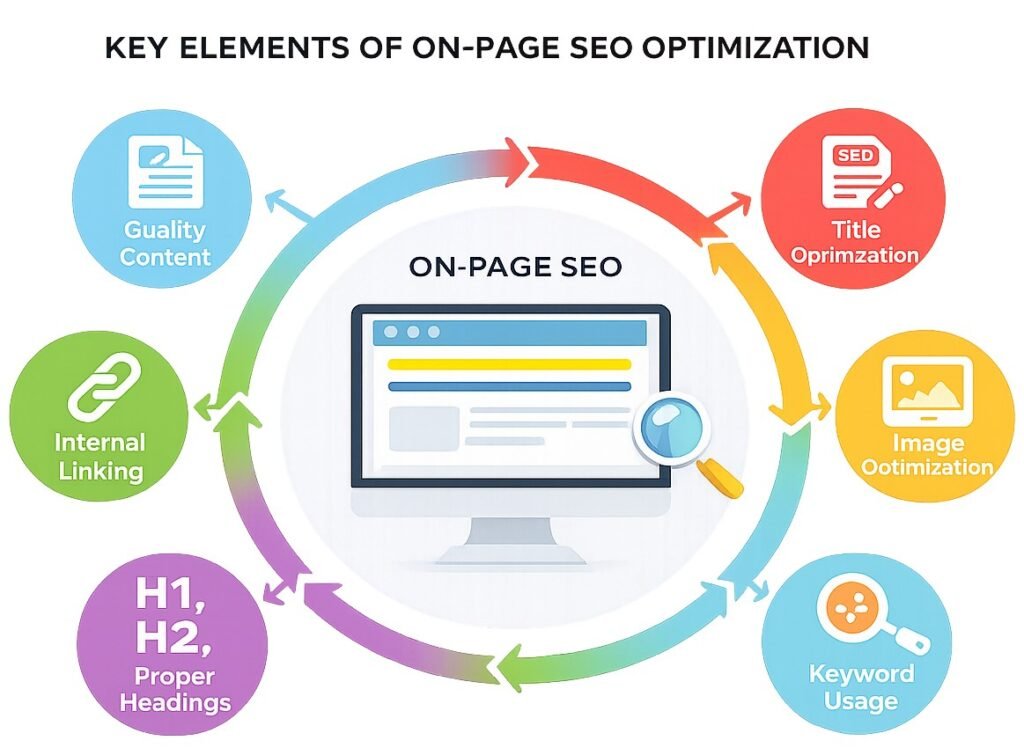
The core elements of on-page SEO help improve both search engine understanding and user experience. Beginners should focus on optimizing content structure, keyword placement, headings, internal links, images, and meta information. These elements work together to make pages more helpful, organized, and SEO-friendly.
4.1: Title Tags
Title tags are one of the most important parts of on-page SEO. A clear and keyword-focused title helps search engines understand the topic of the page and encourages users to click on the result in Google Search. Beginners should create titles that are readable, descriptive, and naturally include the target keyword without stuffing unnecessary words.
4.2: Meta Descriptions
Meta descriptions provide a short summary of the page content in search results. Although they are not a direct ranking factor, strong meta descriptions can improve click-through rate (CTR). A good meta description should explain the topic clearly, include the main keyword naturally, and encourage users to visit the page.
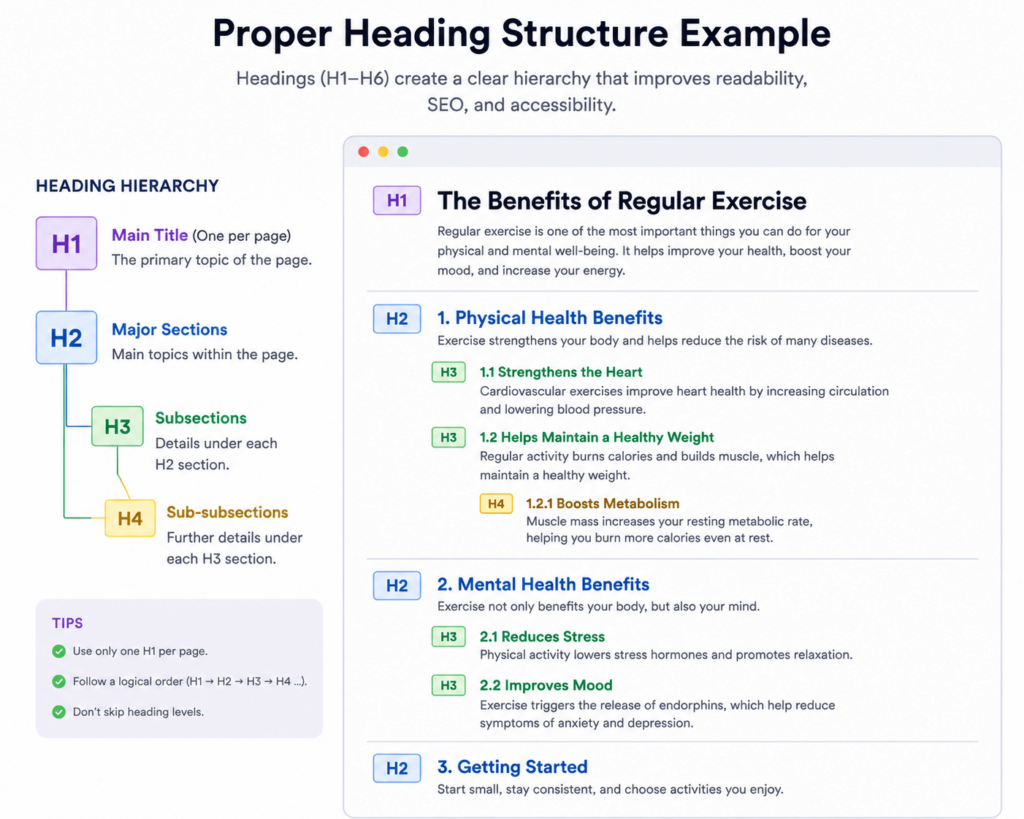
Example of proper H1, H2, and H3 heading structure for on-page SEO
4.3: Headings (H1, H2, H3)
Proper heading structure improves readability and helps search engines understand content organization. The H1 heading should clearly explain the main topic, while H2 and H3 headings divide the content into logical sections. Beginners should avoid using headings only for styling purposes and instead use them to organize information properly.
4.4: Keyword Placement
Keyword placement means adding your target keywords naturally in important areas of your content so search engines can better understand the topic of the page. Important places include the title tag, headings, introduction, URL, meta description, image alt text, and the main content. However, keywords should always sound natural and helpful for readers instead of being forced repeatedly. Proper keyword placement improves content relevance, user experience, and on-page SEO performance. Beginners can also learn keyword research fundamentals from this detailed keyword research guide for beginners.
4.5: Internal Linking
Internal links connect related pages within the same website and help users discover more useful content. They also help search engines understand the relationship between pages and improve crawling. For example, a beginner on-page SEO guide can internally link to a keyword research guide or SEO learning journey article.
4.6: Image Optimization
Optimized images improve both SEO and page performance. Beginners should compress large images, use descriptive file names, and add clear alt text that explains the image content. Proper image optimization helps search engines understand visuals and improves accessibility for users.
4.7: URL Structure
SEO-friendly URLs should be short, clear, and descriptive. Beginners should avoid unnecessary numbers, random characters, or long URLs. A clean URL structure helps both users and search engines understand the topic of the page more easily.
5. Difference Between On-Page SEO and Off-Page SEO
Understanding the difference between On-Page SEO and Off-Page SEO is important for building a complete SEO strategy.
The table below highlights the main differences between On-Page SEO and Off-Page SEO to help beginners understand both strategies clearly.
| Feature | On-Page SEO | Off-Page SEO |
|---|---|---|
| Location | Optimization done inside the website | Optimization done outside the website |
| Examples | Content, headings, images, internal links | Backlinks, social signals, brand mentions |
| Control | Fully controlled by the website owner | Not fully controlled by the website owner |
The main difference between on-page SEO and off-page SEO lies in where the optimization takes place. On-page SEO focuses on optimizing elements within your website, such as content, titles, images, and internal links.
Off-page SEO, on the other hand, involves external factors like backlinks, social signals, and brand mentions from other websites. Both are important for SEO success, but on-page SEO is the foundation. Without strong on-page optimization, off-page efforts will not deliver effective results, as search engines prioritize well-structured and relevant content when evaluating the quality of backlinks and social signals.
6. On-Page SEO Best Practices for Beginners
Beginners should start by focusing on simple and effective SEO best practices. Always use one primary focus keyword and include it naturally in the title, meta description, URL, and first paragraph of the content.
Use short paragraphs, clear headings, and bullet points to make content easy to read. Optimize images by reducing file size and adding descriptive alt text. Also, ensure your website is mobile-friendly and loads quickly. Consistency and clarity are key when applying SEO optimization techniques.
7. Common On-Page SEO Mistakes
One of the most common on-page optimization mistakes is keyword stuffing, which can harm rankings instead of improving them. Another mistake is ignoring meta titles and descriptions or writing duplicate content across multiple pages.
Many beginners also forget to optimize images, use proper heading structure, or link related content internally. Avoid these mistakes by following SEO best practices, keeping content user-focused, and regularly updating your pages.
According to Google’s official SEO documentation, structuring your content correctly helps search engines understand your pages better and improves your chances of ranking higher in search results.
8. Conclusion
If you are starting your SEO journey, it is important to build strong fundamentals step by step instead of trying to learn everything at once. Understanding basic SEO concepts, content structure, keyword usage, and search intent can make future learning much easier and more practical. You can also read my learning SEO from scratch day 1 experience to understand how beginners can start learning SEO in a structured and realistic way.
9. Quick Summary
Proper page optimization helps search engines better understand your content. By optimizing titles, headings, content, and images, beginners can significantly improve their website rankings.
10. Frequently Asked Questions about On-Page SEO
10.1: What is SEO page optimization?
On-page SEO is the process of optimizing individual web pages to improve their visibility in search engines. It includes optimizing elements such as titles, headings, content, images, internal links, and meta descriptions to help search engines better understand the page.
10.2: Is SEO page optimization important for beginners?
Yes, page-level SEO is essential for beginners because it is the foundation of search engine optimization. By optimizing content, headings, and page structure, beginners can help search engines understand their website and improve their chances of ranking higher in search results.
10.3: How long does on-page SEO take?
On-page SEO improvements can be implemented quickly, but results usually take a few weeks to appear. Search engines need time to crawl and evaluate the changes before rankings improve.
10.4: What is the difference between on-page and off-page SEO?
On-page SEO focuses on optimizing elements within a website, such as content, headings, and images. Off-page SEO focuses on external factors like backlinks, brand mentions, and social signals to improve the website’s authority.
10.5: What tools help with on-page SEO?
Several tools can help with on-site SEO, including Google Search Console, Google Analytics, and SEO plugins like Rank Math. These tools help analyze website performance and identify areas for optimization.
11. Final Thoughts about Page-Level SEO
Search engines like Google recommend optimizing pages with clear headings, useful content, and proper internal links.